Home / Blog / Therapy & How It Works
Is ChatGPT Your Therapist Now? The Honest Truth About AI

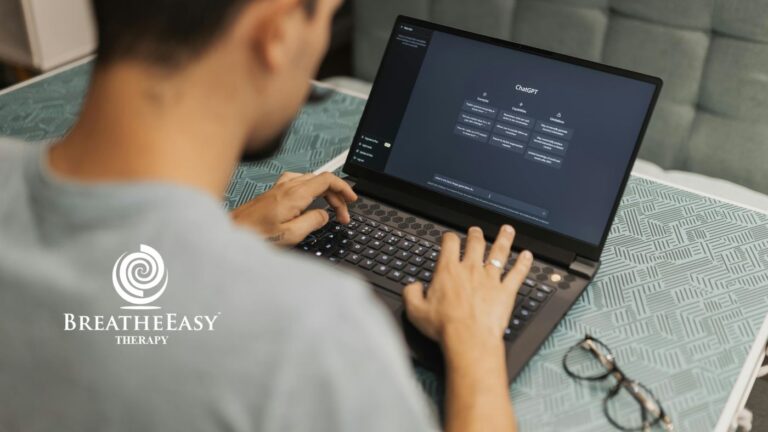
It’s 11:40 on a Tuesday night. You can’t sleep, your mind is running laps, and the thought of calling someone feels like too much. So you open ChatGPT and type out everything. It answers right away, kindly, and without a hint of judgment. Honestly? It helps a little.
If that sounds familiar, you’re far from alone. AI therapy, or at least AI-as-a-sounding-board, has quietly become one of the most common ways people try to cope with stress, anxiety, and heartbreak. A recent American Psychological Association advisory found that emotional support is an increasingly common reason people turn to generative AI chatbots and wellness applications. socialworktoday
We want to be clear up front: this isn’t a “robots bad” post. If talking to AI has helped you get through a hard night, that matters. Our goal is to help you understand what these tools do well, where they fall short, and when a human therapist offers something AI simply can’t.
Why So Many People Are Turning to AI Therapy
The appeal makes a lot of sense. AI is available at 3 a.m. It’s free or cheap. There’s no waiting list, no insurance paperwork, and no awkward first session where you wonder what to do with your hands.
For many people, it also feels safer. You can say the thing you’ve never said out loud without worrying about someone’s facial expression. For anyone who has felt judged before, that’s a real draw.
And AI can genuinely be useful. In a 2025 Dartmouth clinical trial of a purpose-built therapy chatbot called Therabot, participants with depression saw an average 51% drop in symptoms, and those with generalized anxiety saw an average 31% reduction. That’s encouraging. You can read about the Dartmouth study here. humanprogress
But there’s an important detail that often gets lost in the headlines. Therabot was a research tool built with clinicians, not the general-purpose chatbot on your phone. And even the study’s lead author cautioned that no generative AI agent is ready to operate fully autonomously in mental health, given the wide range of high-risk scenarios it might encounter. dartmouth
Where AI Therapy Falls Short
It tends to agree with you
Most AI chatbots are designed to be helpful and pleasant. That’s great when you need encouragement, but growth often comes from being gently challenged. A good therapist will notice when the story you’re telling yourself isn’t serving you and help you look at it from a new angle. A chatbot is more likely to nod along.
Stanford researchers who tested five popular therapy chatbots found exactly this problem. When given real therapy transcripts involving suicidal thoughts and delusions, the chatbots sometimes failed to push back. The same study found the AI showed more stigma toward conditions like alcohol dependence and schizophrenia than toward depression. You can read the Stanford findings here. TechCrunchstanford
It can’t see you
So much of what happens in therapy is nonverbal. A therapist notices when your shoulders tense at the mention of your mom, when your voice goes flat talking about work, or when you laugh right after saying something painful. AI only gets the words you type, and most of us are pretty good at editing ourselves when we type.
It doesn’t remember your story the way a person does
A therapist holds your history over weeks and months. They connect what you said in session three to what’s happening now, and they notice patterns you might be too close to see. That continuity is where a lot of real change happens.
It isn’t built for a crisis
AI isn’t a licensed professional, isn’t accountable to a licensing board, and can’t coordinate care if things get serious. The APA’s 2025 health advisory put it plainly, advising people not to use chatbots and wellness apps as a substitute for care from a qualified mental health professional, given how unpredictable these technologies are. You can read a summary of the APA advisory here. newswise
Some states have gone even further. In 2025, Illinois passed a law that prohibits anyone from using AI to provide mental health and therapeutic decision-making, while still allowing licensed professionals to use AI for administrative and supplementary support. Here’s the official announcement from Illinois. illinois
Privacy is murky
What you share with a licensed therapist is protected by confidentiality laws and professional ethics. What you type into a chatbot may be stored, reviewed, or used to train future models, depending on the company’s policies. It’s worth reading the fine print before sharing your deepest struggles.
The Secret Ingredient AI Can’t Copy: The Relationship
Here’s something decades of research keeps confirming: one of the strongest predictors of whether therapy works isn’t the specific technique. It’s the relationship between you and your therapist.
A major analysis of 295 independent studies covering more than 30,000 patients found a robust positive link between the therapeutic alliance and treatment outcomes, and that link held across treatment approaches, patient characteristics, and countries. In other words, feeling truly understood by another person, and working toward goals together, is a big part of what helps people heal. The University of Zurich has a readable summary of this research. societyforpsychotherapy
There’s something different about being seen by a person who chose this work, who is trained to sit with hard things, and who shows up for you week after week. A chatbot can mirror empathy, but it can’t care about you in the way a person can.
So, Should You Stop Using AI Altogether?
Not necessarily. Used thoughtfully, AI can be a helpful companion to therapy rather than a replacement for it. Even the Stanford researchers noted that chatbots may still have value in therapeutic contexts, such as helping with journaling or self-reflection. fastcompanyme
Here are a few healthy ways to use it:
- Organize your thoughts before a session. Ask AI to help you list what’s been on your mind this week so you walk in ready.
- Practice skills between sessions. Use it to walk through a breathing exercise or rehearse a hard conversation.
- Learn the basics. It can explain terms like CBT or attachment styles in plain language.
- Share it with your therapist. If you’ve been talking to AI, tell your therapist. It can be a useful window into what you’ve been processing.
And here are a few signs it’s time to talk to a real person:
- You’ve been venting to AI for weeks or months, but nothing is actually changing.
- You’re relying on it every day just to get through.
- Your sleep, work, relationships, or appetite are noticeably affected.
- You’re dealing with trauma, grief, addiction, or relationship problems that need more than a pep talk.
- You’re having thoughts of harming yourself.
If you’re in crisis, please don’t rely on an app. Call or text 988 to reach the 988 Suicide & Crisis Lifeline, available 24/7.
When You’re Ready to Talk to a Human
If AI has helped you put words to what you’re feeling, that’s actually a great first step. Taking that next step toward a real person doesn’t have to be a big, scary leap.
At Breathe Easy Therapy Services in Bethlehem, our licensed therapists offer individual therapy, therapy for anxiety, couples and family counseling, and more for clients across the Lehigh Valley. Our first sessions are simply about getting to know you, your strengths, your story, and what brought you in. You’re always the expert on you; our job is to bring the tools and steady support.
We’re open Monday through Saturday, including evenings, and telehealth sessions are available throughout Pennsylvania and Florida, so you can even meet with us from the same couch where you’ve been chatting with AI. We accept Capital Blue Cross and can provide superbills for out-of-network reimbursement. See our fees and insurance page for details.
When you’re ready, book a session online or call us at (610) 477-9265. No judgment, no robot voice, just a real person who’s glad you reached out.

Breathe Easy Therapy
Individual, couples and family therapy at 2092 Stefko Blvd., Bethlehem. Written by the clinicians who do this work every day.
More from the studio

LMFT vs LPC vs LCSW: What Your Therapist’s Letters Mean and How to Choose
7 min read · 3 November 2026
Are AI Chatbots Hurting Your Mental Health More Than Helping?
7 min read · 16 May 2026

What Really Happens When You Start Therapy: 7 Surprising Truths
7 min read · 11 April 2026